
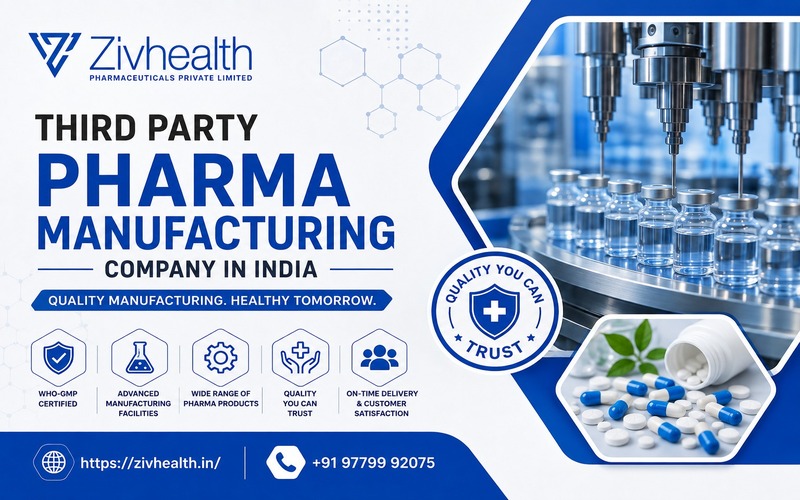
The Indian pharmaceutical sector is widely acknowledged as the “pharmacy of the world.” Indeed, a growing network of contract manufacturing is powering this reputation. Are you planning to launch your own pharma brand? Or, are you looking to diversify your existing product offerings? Perhaps you want to start a PCD franchise instead. In any case, one smart move is to connect with a decent Third Party Pharma Manufacturing Company in India. Essentially, this business structure lets you brand, market, and distribute products. Meanwhile, a certified, existing firm takes care of manufacturing.
This article, therefore, covers what third party manufacturing involves. Additionally, it explains why it’s growing rapidly in 2026. Furthermore, you’ll find its advantages, industry statistics, and tips to find the right manufacturing partner.
For more insights on the pharma and healthcare ecosystem, visit zivhealth.in.
What Is a Third Party Pharma Manufacturing Company in India?
A third-party manufacturer has a WHO-GMP certified production line. As a result, it can manufacture pharmaceutical drugs on your behalf. This includes filling, packaging, and delivery under your own brand name. Commonly, this service is known as contract manufacturing. Alternatively, it’s also called a loan license facility. Because of this model, you save capital expenditure. Similarly, it cuts down regulatory approval time. Moreover, it reduces the lengthy setup process needed for your own plant. Instead, you simply collaborate with a WHO-GMP certified company. After all, they already have the infrastructure, equipment, and personnel ready.
In this arrangement, you, as the brand owner, provide the formulation and packaging artwork. Meanwhile, the manufacturing company handles production, quality control, and supply.
Notably, this model works well for start-ups too. In fact, they can expand their product range without increasing fixed expenses.
Why Third Party Pharma Manufacturing Is Growing Rapidly in India
India is among the biggest drug-making economies globally. In fact, its drugs reach more than 200 nations worldwide. By 2026, therefore, demand for reliable Third Party Pharma Manufacturing Companies in India will skyrocket. Consequently, pharma startup owners, PCD franchise companies, and international buyers all prefer outsourcing. Often, it’s better than launching their own plants.
The increasing demand, moreover, comes from several factors:
- Lesser investment needed – Setting up an independent plant, for instance, costs multiple crores. In contrast, outsourcing costs much less.
- Swift market launch – New brands can launch in a few weeks. However, setting up your own unit can take years.
- State-of-the-art infrastructure – Thousands of WHO-GMP approved hubs, for example, exist across Baddi, Chandigarh, Ahmedabad, Hyderabad, Mumbai, Sikkim, and Uttarakhand. As a result, owners gain access to world-class facilities.
- Growing PCD franchise business – As franchises expand across India, they increasingly need third-party manufacturers to meet rising demand.
- Export market access – Many manufacturers, additionally, hold US-FDA approval. Therefore, they become ideal partners for companies wanting to enter international markets.
Current Industry Statistics and Trends (2026)
India supplies pharmaceutical products to nearly 200 nations. This, therefore, shows the scale and trust placed in its manufacturing sector. Thousands of WHO-GMP certified units, moreover, operate across the country. Many, in particular, are located in recognized pharma clusters like Ahmedabad, Baddi, Sikkim, and Hyderabad.
By 2026, about 34% of all new pharma brand launches are expected through outsourced production. Similarly, 35% of new PCD franchise product lines will rely on third-party manufacturing.
India, furthermore, has several large domestic pharma groups. Additionally, it has hundreds of medium-sized specialty manufacturers. Together, they cater to third-party needs across tablets, capsules, syrups, injectables, ointments, and nutraceuticals.
Overall, industry experts agree on one thing: contract manufacturing will be the biggest growth driver in pharma business in coming years. Indeed, even large pharmaceutical giants maintain third-party manufacturing arms. This clearly proves how vital this segment is for India’s global pharma growth.
Key Benefits of Partnering with a Third Party Pharma Manufacturing Company in India
1. Big Money Savings
Building your own facility, first of all, requires massive capital. You’d also need expensive machines, skilled workers, and compliance infrastructure. Instead, outsourcing frees up this money. As a result, you can invest it in advertising and brand promotion.
2. Quality Assurance through Certification
A trusted manufacturing partner, generally, follows WHO-GMP, ISO, and often US-FDA standards. Consequently, this ensures every batch meets strict quality requirements. This applies to both domestic and global markets alike.
3. Large Portfolio of Products
Good contract manufacturers, typically, offer diverse dosage forms. For example, this includes tablets, capsules, injections, syrups, and ointments. Many also offer nutraceutical lines. As a result, this helps brand owners build a varied product range.
4. Quicker Turnaround and Scalability
Manufacturing partners already have production lines ready. Therefore, this means faster order fulfillment. Additionally, their facilities can scale up as your demand grows.
5. Help with Regulatory Approvals
Drug licensing applications, admittedly, can be complex. Similarly, packaging regulations and documentation add to the challenge. Fortunately, the right manufacturing partner guides you through this entire process.
6. Focus on Core Competencies
Consequently, you can focus on brand management and doctor liaison. You can also prioritize distribution expansion and sales. Meanwhile, daily manufacturing operations won’t slow you down.
How to Choose the Right Third Party Pharma Manufacturing Company in India
Choosing the correct partner, undoubtedly, is critical. After all, your brand identity depends on product quality and consistency. Below, therefore, is what to check before partnering:
1. Quality certifications and compliance
First, check for WHO-GMP and ISO certifications. Also, verify US-FDA approval if you need it. These certifications, in turn, confirm strict quality and hygiene standards at the facility.
2. Manufacturing infrastructure and capacity
Next, examine the machinery and production capabilities. Specifically, make sure they match your desired formulations, such as tablets, capsules, injectables, or liquids.
3. Product range and formulation specialization
Ideally, pick a company with expertise across multiple therapeutic segments. This way, you can expand your range later without switching partners.
4. Locational benefits and supply chain
Manufacturing hubs like Baddi, Ahmedabad, and Hyderabad, for instance, offer strong supply chain advantages. Consequently, this reduces transit time to your distribution points across India.
5. Minimum order quantities (MOQ) policy
Additionally, check the manufacturer’s MOQ policy carefully. Make sure it aligns with your current market needs.
6. Labeling and packaging facilities
Since you’ll sell under your own brand, therefore, explore their packaging options. Also, check labeling design and customization capabilities.
7. Past record and client feedback
Finally, review the company’s credibility and years in business. Likewise, check feedback from current clients. This reflects their consistency in quality and on-time delivery.
Looking to enter the pharmaceutical business? Or, do you need help selecting a manufacturing or franchise partner? Either way, zivhealth.in can assist startups venturing into pharmaceuticals.
Step-by-Step Process to Start with a Third Party Pharma Manufacturing Company in India
- Define product requirements – First, decide your therapeutic segment, dosage forms, and initial product list.
- Shortlist manufacturers – Next, consider three to five manufacturers. Then, shortlist based on certifications, infrastructure, and cost.
- Get samples and documentation – Before finalizing, request product samples and batch test reports.
- Discuss packaging and branding – Subsequently, finalize your brand name, packaging design, and labeling requirements.
- Sign a formal agreement – Make sure the contract covers pricing, MOQ, delivery timelines, and quality assurances.
- Place your first production order – Initially, start with a medium batch size. This helps you gauge market response before scaling up.
- Build distribution channels – Afterward, work with your own sales team. Alternatively, appoint a PCD franchisee or distributors.
- Monitor quality consistently – Finally, track batch quality and delivery timelines. This, in turn, builds customer trust and retention.
Common Challenges and How to Overcome Them
Variable quality: To begin with, choose a manufacturer with documented, certified quality control. Also, ensure a clear track-and-trace process exists.
Lead time: Similarly, confirm the manufacturer ships goods in a timely, organized manner. Otherwise, delays can hurt your market presence.
Compliance: Meanwhile, ensure all necessary paperwork is provided for drug licensing support.
Branding: Lastly, negotiate packaging and branding customization upfront.
Future Outlook for Third Party Pharma Manufacturing in India
Overall, the future looks strong for this sector. Demand for affordable generic medicines, for instance, is rising steadily. Similarly, PCD franchise networks are expanding rapidly. Export prospects, too, are growing. Additionally, more entrepreneurs are entering healthcare with limited funding. As a result, external manufacturing remains one of the fastest, most scalable ways to enter this market. Ultimately, firms that prioritize quality certification and reliable partnerships will lead the pack.
Frequently Asked Questions (FAQs)
Q1. What is third party pharma manufacturing?
Essentially, it’s a business model where another company handles physical manufacturing. Meanwhile, the brand owner focuses on selling, distributing, and marketing the medicines.
Q2. Is partnering with third-party manufacturers profitable?
Yes, definitely. It reduces your initial capital investment and operational costs. As a result, this ensures higher returns on investment. Consequently, you can invest more in promotion and distribution instead.
Q3. Are third party manufacturers in India certified?
Yes, generally. Many are ISO, WHO-GMP, and sometimes US-FDA certified. Therefore, these manufacturers maintain stringent quality standards.
Q4. What kind of medicines can be manufactured through this model?
Broadly, this model covers tablets, capsules, injectables, syrups, ointments, and nutraceuticals.
Q5. Why is India becoming a global outsourcing hub for third-party pharma manufacturing?
Primarily, India offers a vast market, strong production capabilities, and an expert workforce. Additionally, it provides cost-effective development and strict quality standards. Altogether, this makes it a top global destination for outsourced pharma manufacturing.
Conclusion
In summary, finding a Third Party Pharma Manufacturing Company in India is a smart move for many entrepreneurs. Indeed, it offers enormous cost savings. Moreover, you gain access to certified standards like WHO-GMP. As a result, market entry becomes faster, and business risks go down. Overall, this venture has proven productive and adaptable for building a strong pharma brand. Demand, undoubtedly, will keep growing through 2026 and beyond. Therefore, partnering with a certified, well-equipped, and experienced manufacturer should be the cornerstone of your endeavor.
